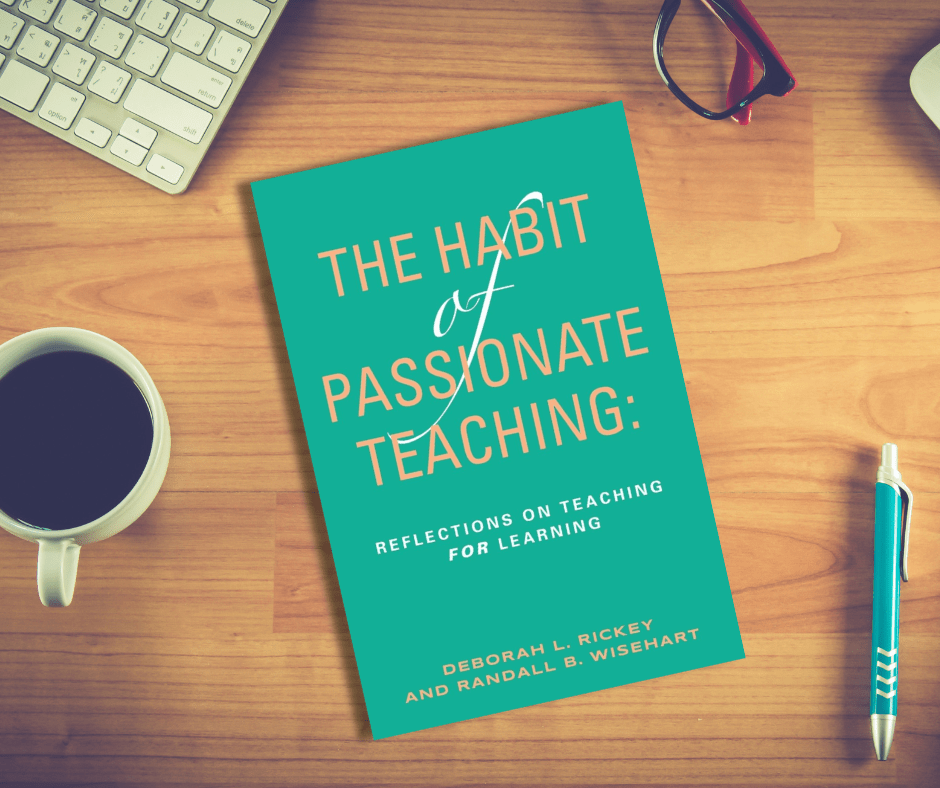
I wrote this book with Debbie Rickey, my colleague of many years. We built on interviews and meetings with teachers throughout the years who shared with us what kept them in the teaching profession, what helped them become and remain passionate teachers. At a time when many educators are leaving the profession, this book shares inspiration from educators who have remained in the profession for five, ten, even twenty or more years. Their voices resonate throughout the book
Practices lead to Habits
The educators we interviewed shared with us what has sustained them in their teaching careers. Based on their stories and insights, we discovered that they had something in common: they engaged in certain practices that led to the habit of passionate teaching. What did these teachers routinely do? They built positive relationships with students. They routinely reflected on their practice. They created and nurtured classroom/school cultures that supported student learning. They routinely asked their students for input and acted on the student input. These practices and more led to the habit of passionate teaching.
You can read the first few chapters on the BookLocker website to find out more. https://booklocker.com/books/13328.html
The following trailer introduces our book. We hope you enjoy it.
Practices of Passionate Teachers
We offer the following list as a starting point for an exploration of the practices of passionate teachers. We emphasize “starting point” for a couple of reasons. (1) There could be other practices that are a good fit in the context of teaching for learning. We encourage all educators to reflect on other practices that fit with our list. (2) Our own understanding of these practices has evolved over time with our experiences and the experiences of our graduates. We encourage all educators to build on what we have written.
Passionate Teachers Teach from the Inside Out
Passionate teachers teach from within and know themselves well. They focus on the content their students need to learn but never lose sight of their own humanity and the humanity of their students (Palmer, 2007). This also includes understanding they must challenge assumptions about learning and teaching as part of knowing oneself. By routinely looking for opportunities to challenge assumptions, passionate teachers are continually honing their beliefs about learning, teaching, and their bottom lines.
Teachers who teach from the inside out know their own strengths and limitations. They can discern when to put in extra hours planning or grading and when to take a break to renew their energy.
Passionate Teachers Teach Who They Are
For passionate teachers, understanding who they are is crucial as a basis for forming meaningful relationships with their students. They engage in introspection in order to understand who they are as a teacher and, they ask, as Palmer (2007) often asks, “Who is the self that teaches?” They understand the importance of exploring their beliefs and priorities and regularly check to make sure their activities, assignments, assessments, and expectations are consistent with who they are as a teacher.
In practice, teachers who teach who they are make sure they have clearly expressed their beliefs about learning for teaching. They have written a list or created a visual they can look at from time to time throughout the year and compare what they say they believe to what they are actually doing.
Passionate Teachers Seek to Understand Students as People and as Learners
Passionate teachers intentionally build a classroom community based on the belief the job of a teacher is to engage with real people in the exploration of important ideas in a discipline; they do not merely dispense information and hope anonymous students are able to repeat it. In a classroom of a passionate teacher, a teacher might ask individual students to reflect on the following questions in writing or during a meeting: “What are your strengths as a learner? What are a couple of challenges you think you’ll face in this class?” Then after reviewing this information, a teacher might ask: “What will you do in this class to build on your strengths? What might you do to meet one of the challenges? What do you need from me to meet one of your challenges?” Passionate teachers experience teaching as a relationship with individual students. They teach students—not subjects.
Passionate Teachers Build Positive Relationships
Passionate teachers intentionally forge positive relationships with students and colleagues. They include parents and the community when appropriate and make decisions about teaching and learning based on knowing their students. A key aspect of these positive relationships is having high expectations for students, believing in their potential to excel, and a commitment to helping all students learn. Rob Fried calls this “stance” (Fried, 2001).
Passionate Teachers Continuously Reflect
Passionate teachers reflect in a number of contexts: after engaging with professional knowledge; before, during, and after instruction; alone, with colleagues, and with students; when working on curriculum and lesson planning. Whether thinking about students or teachers, learning doesn’t take place without reflection and reflection must be modeled and explicitly taught in classrooms; and it is as crucial for secondary school students as it is for teacher candidates or veteran teachers and principals. Good teachers reflect before, during, and after teaching (Cochran-Smith & Lytle, 2009; Schon, 1983).
Passionate Teachers Nurture Communities of Learners
Passionate teachers understand that K-12 school classrooms, K-12 schools, and college teacher education classrooms are communities of learners. They invite students into the learning community, first by making sure they and their students have a shared understanding of what it means to be part of a community focused on learning.
As teacher educators, we modeled and applied some ideas from the Earlham College principles and practices (Earlham College, 2023), making sure they were woven throughout the program. These principles— acknowledging the worth of each human being, engaging in conflict resolution that values diverse viewpoints, implementing principles of consensus decision making so all members of the community have some degree of power, advocating for equity in a wide range of situations—are foundational to the creation of those communities of learners that support passionate teaching.
Passionate Teachers Have an Action Research Mindset
Passionate teachers are always posing questions, challenging implicit assumptions, and using the results to make changes. Questions permeate their practice, and they continuously engage in inquiry and engage with professional learning. We call this having an action research mindset. Passionate teachers are always in a cycle of posing questions about their practice, gathering data, reflecting, and analyzing the data, asking colleagues for input, and then deciding whether to pose a new question or continue to explore the current question. This practice of being in an action research mindset guides passionate teachers to make decisions about their work and their classrooms. Passionate teachers ask questions, challenge assumptions, and model an action research mindset in order to bring about a change for their students.
Passionate Teachers Teach with Students, Not at Students
Passionate teachers experience teaching as a process they undertake with students not something to do to students. A favorite phrase we used often was “when in doubt, ask your students.” Passionate teachers explicitly build time into their instruction to actively listen to students and use student input to improve their instruction and assessment. They are not satisfied with merely asking students for feedback at the end of a semester or end of a unit. Instead, passionate teachers directly ask students for feedback as a natural part of teaching, sometimes on a daily basis.
One efficient way to build this into a school day is to utilize that often problematical last few minutes of class when students are anxious to put away materials so they can stare at the clock waiting for the bell to ring. A teacher could pass out half sheets of paper and with five minutes left in class say: “On this paper, write down three important things you learned today and one question. I’ll stand at the door and collect them as you leave. Ready? Go!” Often a teacher who reviews these slips from their students recognizes what students seem to be learning and where they are confused. Making adjustments based on this feedback makes students and teachers partners in learning.
Adapted from The Habit of Passionate Teaching: Reflections on Teaching for Learning. Rickey, D. & Wisehart, R. (2024).
 Randall Wisehart